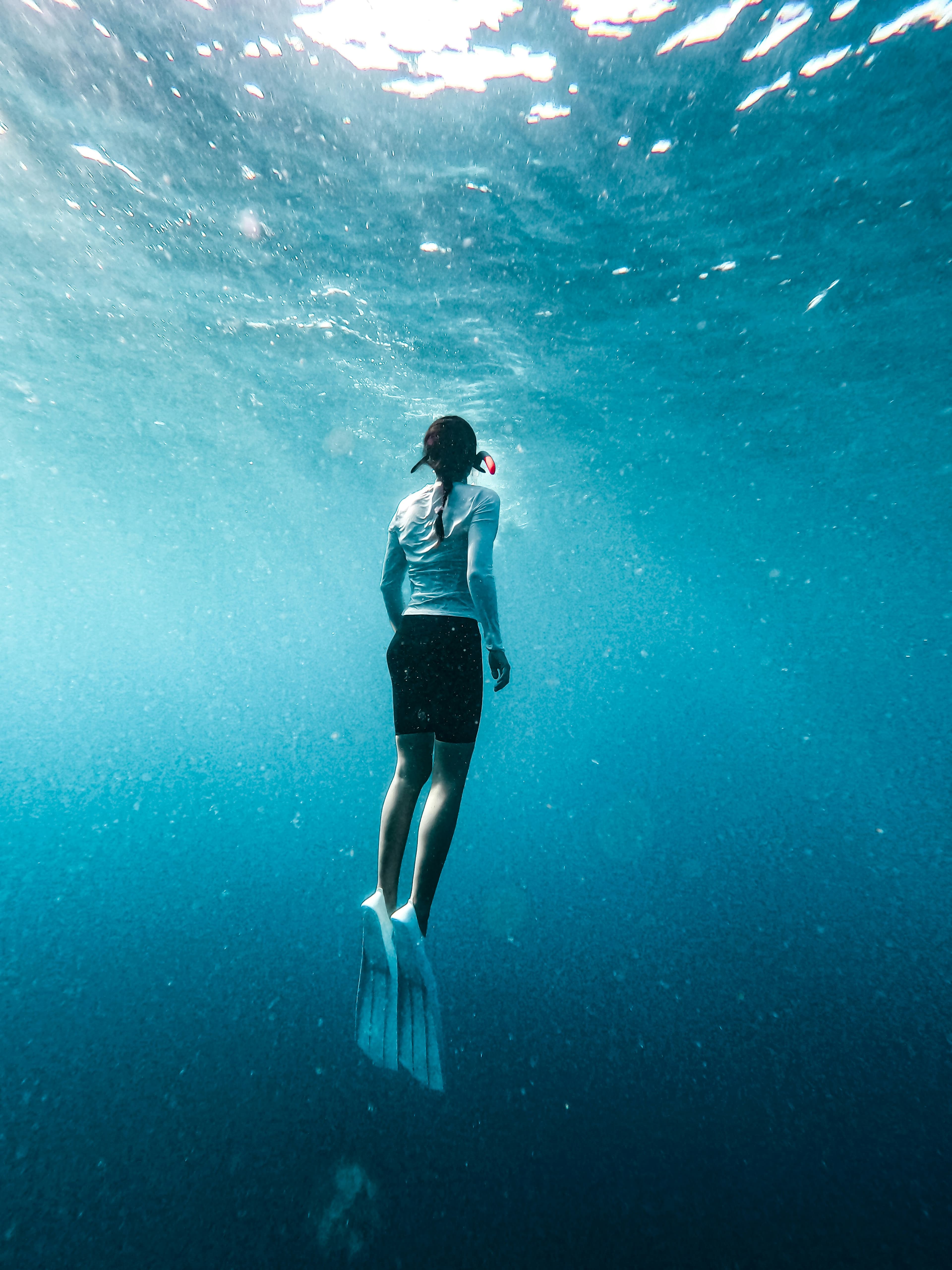
Why Do People Freedive? The Psychology and Joy Behind Breath-Hold Diving
William Trubridge, who holds the world record for diving to 102 meters without fins, opens his TED Talk with a profound reminder about our first breath hold—in the womb. People freedive for reasons that go far beyond just seeing fish or chasing depth records. Based on interviews with world champions, community discussions, and research, the motivations are deeply rooted in mental health, sensory experience, and a unique biological "reconnection" that many describe as transformative.
1. The "Mental Reset" and Active Meditation
For many freedivers, the sport is a form of active meditation. Because the body cannot relax if the mind is racing, freediving forces a state of total presence that's difficult to achieve through traditional meditation. This connects directly to breathing techniques that form the foundation of the practice.
What the Champions Say
Guillaume Néry (World Champion) describes freediving as "a philosophy, a way to think better." In his TED Talk, he explains:
"Today, in the 21st century, we're under so much pressure. Our minds are overworked, we think at a million miles an hour, we're always stressed. Being able to freedive lets you, just for a moment, relax your mind. Holding your breath underwater means giving yourself the chance to experience weightlessness."
Natalia Molchanova (42 World Records) put it beautifully: "Freediving is not only sport, it's a way to understand who we are. When we go down, if we don't think, we understand we are whole. We are one with world."
Suzy Malseed (Australian Competitive Freediver, ADHD advocate):
"When I first went underwater was the first time in my whole life I have ever experienced silence. Like, my whole mind just went quiet. And that is what I am probably addicted to the most, is just the quiet."
2. The Feeling of "Flying" — Sensory Freedom
Unlike scuba diving, which involves heavy tanks, buoyancy compensators, and noisy bubbles, freediving is silent and allows for unrestricted movement in three-dimensional space. Divers consistently describe it as the closest experience to flying. Understanding the different freediving disciplines helps appreciate how this sensation varies across the sport.
William Trubridge describes the unencumbered nature of the experience: "Free diving is the only fully aquatic sport, where we're completely submerged below the ocean, enveloped in something other than gas and without a tank of gas on our backs. It's unencumbered immersion; it's the only true way to escape the surface."
Guillaume Néry describes the sensation of "free fall"—the moment when you become dense enough to sink without swimming:
"The free fall phase is the best part of the dive... I can go from 35 meters to 123 meters without making a single movement. I let myself be pulled by the depths, and it feels like I'm flying underwater."
Alexey Molchanov (World Champion, 136m depth) echoes this: "It feels very much like flying actually. Very much like freedom. Just pure joy of flying."
Suzy Malseed describes the unique sensory experience of depth:
"If I dive to 30 meters, I have four atmospheres of pressure on my body. Four times the pressure that we experience walking around on the ground. Now that feels like a giant bear hug, basically. And I love that feeling. It's deep pressure to me. It just feels like a big welcoming hug."
3. Biological Fascination & Self-Mastery
Divers are often drawn to the Mammalian Dive Reflex—the body's ancient ability to slow the heart and shift blood to protect vital organs under pressure. This biological response, governed by Boyle's Law and pressure physics, connects humans to their aquatic evolutionary past.
Guillaume Néry explains the dive reflex in his TED Talk:
"As soon as I leave the surface the first mechanism kicks in: the diving reflex. My heart beat will drop from about 60-70 per minute to about 30-40 beats per minute in a matter of seconds. The blood flow will leave the body's extremities to feed the most important organs: the lungs, the heart and the brain. This mechanism is innate... we share this instinct with marine mammals: dolphins, whales, sea lions."
Recent research has also explored the vagus nerve stimulation benefits that occur during breath-hold diving, which may explain many of the calming effects freedivers report.
Suzy Malseed explains this ancient reflex in practical terms:
"When you immerse your face in water you get a 30% drop in heart rate... It's genetic. It goes back to when we were little, whatever you think we were before. A little fishy somewhere along the line. It's called the mammalian dive reflex."
4. Therapeutic & Personal Growth
Freediving and ADHD
Suzy Malseed, an Australian competitive freediver and ADHD advocate, has spoken extensively about the connection between freediving and neurodivergent minds:
"I think that ADHD is quite highly represented in free diving, to be honest. When I consider other free divers and I look around I see a lot of people who are like me and I believe that we're all drawn to the sport for the same reason, which is like a form of sensory deprivation."
More people are using freediving to manage trauma, anxiety, PTSD, and ADHD. The high-pressure environment demands a level of self-regulation that transfers to daily life. Understanding safety protocols and the buddy system is essential for therapeutic practice.
A 2017 study published in Frontiers in Psychology found that deep, controlled breathing exercises significantly reduced symptoms of PTSD and anxiety. The mammalian dive reflex triggers the parasympathetic nervous system, directly counteracting hyperarousal.
One freediver shared their transformation: "I was sitting in my London apartment, chest tight, eyes dark... It was time for a change. A couple of close friends dragged me out to check out what life is like underneath the waves. This was my introduction to freediving, and it changed my life."
However, it's crucial to understand the risks. Learning about shallow water blackout and proper training is essential before pushing limits.
Suzy Malseed echoes this philosophy:
"You have to find a way to surrender. You have to understand that the more you relax, the better your dive will be, the more tense you are, the worse your dive will be. So you have to switch off and there really is no choice."
5. Practical Reasons: Cost, Convenience & Wildlife
Beyond the profound psychological benefits, many freedivers are drawn to the sport for practical reasons:
Lower cost than scuba diving—minimal equipment needed
Freedom from bulky gear allows natural movement
Silent approach for better wildlife encounters
Portable and travel-friendly—just mask, fins, and wetsuit
As one forum member put it: "I was initially drawn to it because SCUBA is expensive, but I found so much more in it than just that."
For those interested in getting started, understanding what to expect in your first course and comparing certification options is the best first step.
6. Spearfishing: The Food Connection
For many freedivers, spearfishing represents a deeper connection to food systems and sustainability. It's often the gateway to freediving for hunters and fishermen. If you're interested in this aspect, check out our Victoria spearfishing regulations guide.
According to research, spearfishing has been found to be the most environmentally friendly form of fishing due to being highly selective, having no by-catch, causing no habitat damage, and creating no pollution.
Summary: Why People Freedive
The motivations for freediving vary widely:
Elite athletes: Pushing human limits, experiencing the technical beauty of the dive reflex
Recreational divers: Freedom from gear, the "flying" sensation, lower cost than scuba
Mental health seekers: Stress relief, active meditation, flow states
Spearfishers: Sustainable hunting, connection to food source
If you're curious about starting your freediving journey, our complete beginner's guide covers everything you need to know, and our equalization techniques guide addresses the most common challenge new freedivers face.
For more on the connection between freediving and ADHD, listen to the Faster Than Normal Podcast episode with Suzy Malseed.
As Natalia Molchanova beautifully expressed: "Freediving is about feelings, whether it is the euphoria that comes from weightlessness, or our amazement at the beauty of the underwater world. We dive for the moments of joy which come from a deeper understanding of our thoughts and experiences."
Getting Started — Complete Series
- 1What is Freediving? The Complete Beginner's Guide
- 2Why Do People Freedive? The Psychology and Joy Behind Breath-Hold Diving
- 3Freediving Disciplines Explained: Pool, Depth & Everything In Between
- 4Freediving vs Scuba Diving: Key Differences Explained
- 5Beyond the Breath: How Freediving is Used Around the World