Freediving Disciplines Explained: Pool, Depth & Everything In Between
Freediving has eight competitive disciplines recognized by AIDA International: four pool disciplines (STA, DYN, DYNB, DNF) and four depth disciplines (CWT, CWTB, CNF, FIM). Each tests different skills — from pure breath-hold endurance to underwater swimming efficiency to deep vertical diving.
This guide explains what each discipline involves, who it's suited for, current world records, and how to train for each one.
Pool Disciplines
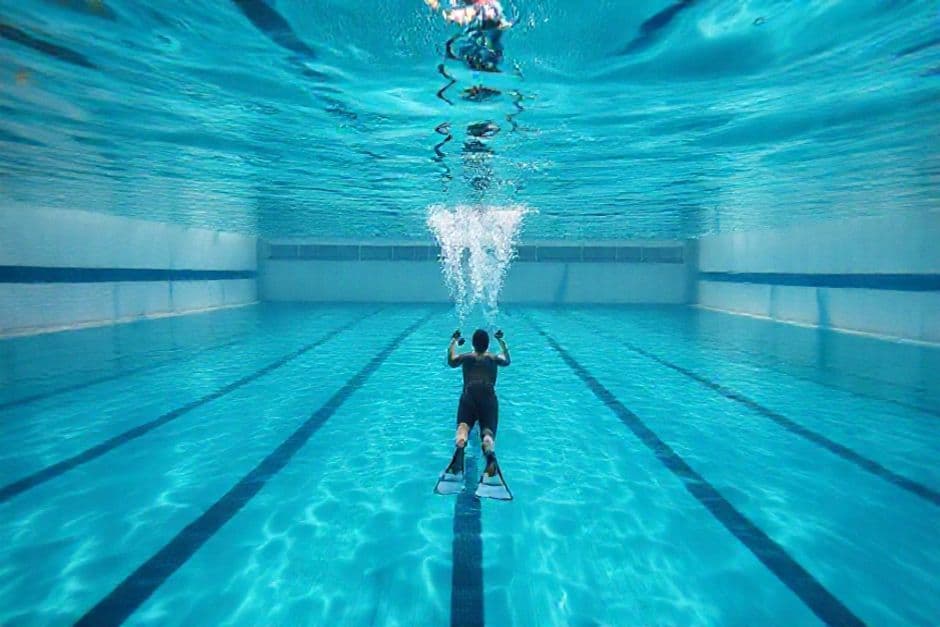
Pool disciplines take place in swimming pools and focus on time (static apnea) or distance (dynamic apnea). They're ideal for beginners because they're done in a controlled, shallow environment with easy safety supervision.
Static Apnea (STA)
Static apnea is holding your breath as long as possible while floating motionless, face-down in the water. It's the only discipline measured by time rather than distance or depth.
What it trains: Pure breath-hold capacity, relaxation under oxygen deprivation, mental control, and CO2 tolerance.
Why freedivers practise it: STA develops the mental toughness and body awareness that transfers to all other disciplines. Learning to stay calm as CO2 rises and contractions begin is fundamental to freediving.
Current AIDA World Records:
Men: Stéphane Mifsud (France) — 11 min 35 sec (2009)
Women: Heike Schwerdtner (Germany) — 9 min 22 sec (2025)
Beginner targets: AIDA 2 certification requires 2 minutes. Most beginners reach 2-3 minutes with basic training. Advanced freedivers aim for 5+ minutes.
Note: Guinness records for oxygen-assisted static apnea (where divers pre-breathe pure oxygen) exceed 24 minutes, but these are separate from competitive freediving records.
Dynamic with Fins (DYN)
Dynamic with fins measures the horizontal distance you can swim underwater on a single breath using a monofin. It's the fastest and most efficient pool discipline.
What it trains: Streamlining, efficient propulsion, oxygen conservation during movement, and the specific muscles used in constant weight depth diving.
Technique: The dolphin kick creates a wave motion from hips through legs to the fin. Arms are locked overhead in a streamlined position. Top athletes travel at 1-1.2 metres per second with minimal effort.
Current AIDA World Records:
Men: Guillaume Bourdila (France) — 301m (2022)
Women: Zsófia Törőcsik (Hungary) — 280m (2025)
Beginner targets: AIDA 2 requires 40m. Most beginners achieve 50-75m. Advanced freedivers aim for 150m+.
Dynamic Bifins (DYNB)
Dynamic bifins uses two separate fins (like scuba fins, but longer) instead of a monofin. AIDA only recognized DYNB as a separate discipline in 2019.
Technique: Flutter kick with long, relaxed legs and arms by the sides. Dolphin kick is not permitted in DYNB. The movement is more natural than monofin for most people.
Why it exists: Bifins are more accessible — they're cheaper, easier to find, and require less technique to use effectively. DYNB allows freedivers who prefer bifins to compete separately from monofin specialists.
Current AIDA World Records:
Men: Mateusz Malina (Poland) — 290m (2022)
Women: Zsófia Törőcsik (Hungary) — 259m (2025)
Dynamic No Fins (DNF)
Dynamic no fins is swimming underwater using only your body — a modified breaststroke with no propulsion equipment allowed. It's the most physically demanding pool discipline.
Technique: A keyhole arm stroke (hands move from overhead to hips) combined with a frog kick. The movement requires exceptional coordination and consumes more oxygen than finned disciplines.
Why it's harder: Without fins, you work much harder to cover the same distance. DNF requires superior technique, conditioning, and oxygen efficiency.
Current AIDA World Records:
Men: Mateusz Malina (Poland) — 250m (2022)
Women: Julia Kozerska (Poland) — 213m (2023)
Beginner targets: AIDA 2 has no DNF requirement. Beginners typically achieve 25-40m. The pool discipline is excellent cross-training for CNF (constant weight no fins) depth diving.
Depth Disciplines
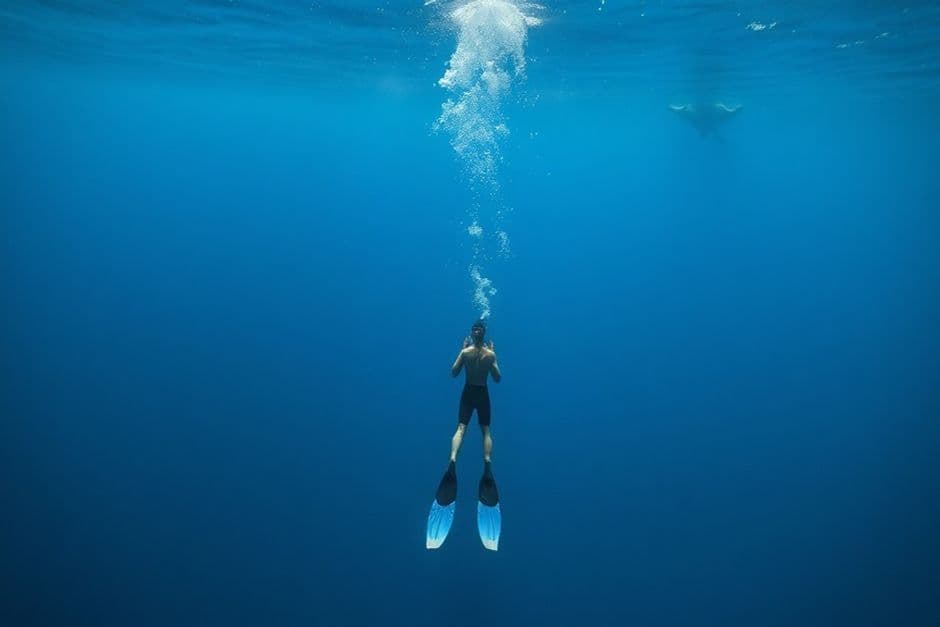
Depth disciplines take place in open water and measure how deep you can dive on a single breath. They require more advanced skills — especially equalization — and stricter safety protocols including safety divers.
Constant Weight with Monofin (CWT)
Constant weight is the flagship discipline of competitive freediving. The diver descends and ascends using only a monofin, carrying the same weight throughout. Pulling on the line is not allowed (except once at the bottom to turn).
Why it's the deepest discipline: The monofin's efficiency allows divers to reach incredible depths. The current world record exceeds 136 metres — deeper than a 45-storey building is tall.
Technique: Powerful dolphin kicks propel the diver down to their point of negative buoyancy (typically 20-30m), then they enter freefall. On ascent, they must swim hard against negative buoyancy before reaching positive buoyancy and gliding up.
Current AIDA World Records:
Men: Alexey Molchanov — 136m (2023)
Women: Alenka Artnik (Slovenia) — 123m (2025)
Beginner targets: AIDA 2 requires 12m CWT. AIDA 3 requires 24m. AIDA 4 requires 32m. Recreational freedivers typically work toward 20-40m.
Constant Weight Bifins (CWTB)
CWTB follows the same rules as CWT but uses bifins instead of a monofin. AIDA recognized it as a separate discipline in 2019; CMAS has tracked it since 2015.
Technique: Flutter kick (not dolphin kick) with arms typically by the sides. The technique is more natural for most people but less efficient than a well-executed monofin kick.
Why it matters: Most recreational freedivers use bifins. CWTB allows them to compete and set records without needing monofin expertise.
Current AIDA World Records:
Men: Alexey Molchanov — 125m (2024)
Women: Alessia Zecchini (Italy) — 109m (2023)
Free Immersion (FIM)
In free immersion, the diver pulls on the rope to descend and ascend — no fins are used. It's often called the most relaxing depth discipline.
Why freedivers love it: FIM conserves energy (no kicking), allows precise speed control, and gives you a free hand for equalization. You can descend head-up, head-down, or switch between them. Many freedivers find the sensation of pulling through water deeply meditative.
Why it's great for learning: FIM is the go-to discipline for developing equalization skills. The slow, controlled descent lets you focus entirely on ears without worrying about finning technique.
Current AIDA World Records:
Men: Petar Klovar (Croatia) — 135m (2023)
Women: Fatima Korok (Hungary) — 102m (2023)
Beginner targets: FIM is often taught alongside CWT in beginner courses. Expect to reach similar depths to your CWT, possibly slightly deeper due to energy savings.
Constant Weight No Fins (CNF)
CNF is widely considered the hardest depth discipline — and the purest form of freediving. The diver descends and ascends using only arm strokes and leg kicks, with no fins and no pulling on the rope.
Why it's the hardest: Without fins or rope assistance, every metre requires significant physical effort. CNF demands exceptional technique, conditioning, and oxygen efficiency. The stroke must be perfectly coordinated — any inefficiency wastes precious oxygen.
Technique: A modified breaststroke: arms sweep from overhead to hips in a keyhole pattern while legs do a frog kick. Most CNF divers use noseclips instead of masks (easier equalization) and wear the lanyard around the waist (avoids tangling with arm movements).
Current AIDA World Records:
Men: Petar Klovar (Croatia) — 103m (2025)
Women: Kateryna Sadurska (Ukraine) — 86m (2025)
Who trains CNF: Typically experienced freedivers looking for the ultimate challenge. CNF requires a strong foundation in CWT and pool DNF before attempting serious depth.
Historical Disciplines: Variable Weight & No Limits
Two additional disciplines exist but are no longer sanctioned for competition by AIDA due to extreme risks.
Variable Weight (VWT)
The diver descends using a weighted sled (typically 10-30kg), then ascends under their own power — swimming, pulling the rope, or using fins. VWT allows deeper dives than constant weight because the heavy sled eliminates the need to swim down.
Variable weight is still practised for training and personal records but is not included in AIDA competitions.
No Limits (NLT)
No Limits is the extreme end of freediving. The diver descends on a heavy weighted sled and ascends using a lift bag filled with air. There's no swimming involved — it's purely a test of depth tolerance and equalization.
AIDA stopped sanctioning No Limits attempts in 2015 due to safety concerns. The risks are severe: equipment failures at depth can be fatal, and the physiological stresses at extreme depths (100m+) push the human body to its absolute limits.
The Audrey Mestre tragedy: In 2002, French freediver Audrey Mestre died attempting to break the No Limits world record at 171m. Her lift bag failed to inflate properly, and inadequate safety protocols delayed her rescue. The tragedy highlighted the extreme risks of No Limits and contributed to its removal from sanctioned competition.
Historical No Limits records exceeded 200 metres, but these achievements came with unacceptable risk and are no longer pursued in organized competition.
Which Discipline Should You Train?
Different disciplines suit different goals, body types, and interests:
For complete beginners:
Static Apnea (STA) — Learn breath-hold basics in the safest possible environment
Dynamic Bifins (DYNB) — Develop underwater swimming with accessible equipment
Free Immersion (FIM) — The gentlest introduction to depth; master equalization first
For depth progression:
CWT or CWTB — The main depth disciplines. Choose monofin (CWT) for maximum depth potential or bifins (CWTB) for a more accessible path
FIM — Often trained alongside CWT; great for warming up and equalization practice
For the ultimate challenge:
CNF — The purest, hardest discipline. Requires years of foundation
DNF — The pool equivalent; excellent preparation for CNF
For competitive freedivers:
Most competitors specialize but train multiple disciplines. Pool disciplines (STA, DYN, DNF) are valuable year-round training when depth access is limited.
Training Tips by Discipline
Pool Training
STA: Practice CO2 and O2 tables 2x per week. Focus on relaxation — the mental game is everything.
DYN: Prioritize streamlining over speed. Perfect neutral buoyancy. Start with soft fins.
DNF: Break down the stroke: practice arms-only and legs-only laps. Coordination is key.
DYNB: Work on flutter kick efficiency. Keep ankles relaxed and legs straight.
Depth Training
CWT/CWTB: DYN is your best pool training for depth. Build the specific muscles and oxygen efficiency.
FIM: Use it as a warm-up discipline before CWT dives. Practice both head-up and head-down pulling.
CNF: Master DNF first. Build exceptional conditioning. Progress slowly — CNF punishes rushing.
All depth: Equalization is the limiting factor for most divers. Train Frenzel, then mouthfill.
For equalization technique, see our equalization guide. For breathing preparation, see breathing techniques for beginners.
Equipment by Discipline
Pool disciplines:
STA: Wetsuit optional, noseclip, goggles or mask
DYN: Monofin, low-volume mask or fluid goggles, wetsuit
DYNB: Long-blade bifins, low-volume mask, wetsuit
DNF: No fins, noseclip, goggles recommended over mask
Depth disciplines:
CWT: Monofin, low-volume mask, wetsuit, weight belt, lanyard, dive computer
CWTB: Long-blade bifins, same as CWT
FIM: No fins, mask or noseclip, wetsuit, weight belt, lanyard
CNF: No fins, noseclip preferred, fluid goggles, waist lanyard, wetsuit
Summary
Freediving's eight competitive disciplines offer something for everyone — from the meditative stillness of static apnea to the explosive athleticism of constant weight, from the accessible path of bifins to the ultimate challenge of CNF.
Most freedivers don't specialize immediately. They explore multiple disciplines, discovering what suits their body, psychology, and goals. The beauty of freediving is that training in one discipline strengthens your abilities in others — pool work builds depth capacity, FIM develops equalization, and STA underlies everything.
Start with a beginner freediving course, develop your foundation, and let the disciplines reveal themselves. The depth record doesn't matter — what matters is the journey of discovering what your body and mind can do.
Ready to start training? Explore our complete freediving guide or find Melbourne training options.
Getting Started — Complete Series
- 1What is Freediving? The Complete Beginner's Guide
- 2Why Do People Freedive? The Psychology and Joy Behind Breath-Hold Diving
- 3Freediving Disciplines Explained: Pool, Depth & Everything In Between
- 4Freediving vs Scuba Diving: Key Differences Explained
- 5Beyond the Breath: How Freediving is Used Around the World