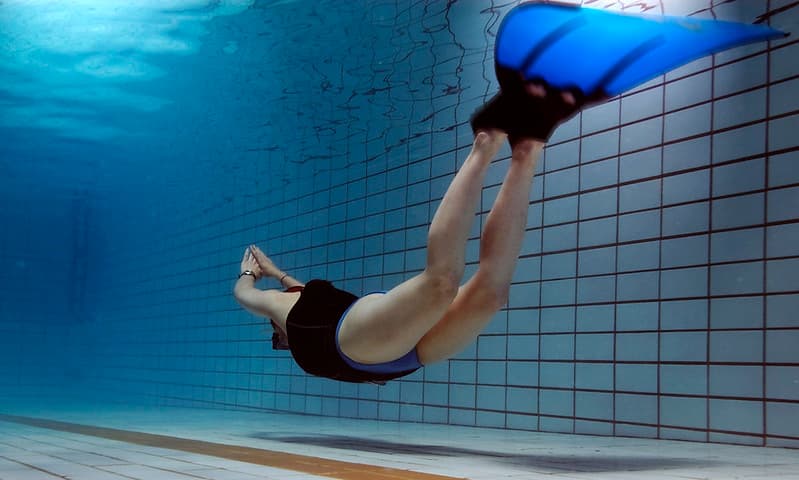
Monofin vs Bifins: Complete Freediving Fins Comparison
One of the first major equipment decisions for a progressing freediver is whether to learn monofin or stick with bifins. Both have distinct advantages, different technique requirements, and specific use cases. This guide compares monofin vs bifins across performance, learning curve, disciplines, cost, and when to make the switch.
What Are Bifins and Monofins?
Bifins (Two Fins)
Standard freediving fins — one long blade for each foot, similar to traditional fins but much longer (80-95cm blades). You kick with an alternating flutter kick, similar to swimming but slower and more controlled.
Blade materials: Plastic, fiberglass, or carbon fiber
Kick style: Alternating flutter or frog kick
Typical for: All disciplines, especially beginners and recreational divers
Monofin (Single Fin)
A single large blade with two foot pockets side-by-side. You kick with a dolphin motion — both legs together, generating power from your core and hips. Think mermaid swimming.
Blade materials: Fiberglass or carbon fiber (plastic monofins are toys, not real freediving gear)
Kick style: Dolphin kick — undulating wave motion from chest to fin tip
Typical for: Competitive depth and pool disciplines, advanced divers
If you're new to freediving, you'll start with bifins. The question is: when and whether to transition to monofin. We've written a complete guide to choosing freediving fins — this post focuses specifically on the bifins vs monofin decision.
Performance Comparison
Speed & Efficiency
Monofin: 10-15% faster in a straight line with proper technique. World records in constant weight (CWT) and dynamic (DYN) are all set with monofins.
Bifins: Slightly slower but more versatile. Easier to maneuver, turn, and adjust body position.
For pure performance in depth or distance, monofin wins. But only with good technique — a poorly executed monofin kick is slower and more exhausting than efficient bifins.
Energy Cost
Monofin: More efficient per kick when done correctly — generates more thrust for less muscular effort. However, bad technique burns oxygen faster than bifins.
Bifins: Forgiving technique. Even suboptimal kicking produces reasonable propulsion.
Elite divers with perfect dolphin kick can reach 100+ meters in depth or 200+ meters horizontally with monofin, depths/distances that would be nearly impossible with bifins at the same oxygen cost.
Depth Capability
Most depth world records are set with monofins:
CWT (monofin): 136m — Alexei Molchanov
CWTB (bifins): 121m — Arnaud Jerald
The 15-metre difference illustrates monofin efficiency at the absolute limits of human performance. For recreational divers, both fins are capable of 30-50+ meters with training. Read about depth limits and progression.
Learning Curve
Bifins: Beginner-Friendly
Familiar kicking motion (similar to swimming)
Easy to learn in 1-2 pool sessions
Immediate feedback — you can feel if your kick is working
Low risk of injury with poor technique
Everyone starts with bifins. They're intuitive, forgiving, and let you focus on breath-hold, equalization, and relaxation without worrying about complex finning.
Monofin: Steep Learning Curve
Requires 6-12 weeks of dedicated pool training to develop proper dolphin kick
Unnatural movement pattern for most people (core-driven undulation, not leg kick)
Poor technique causes lower back strain, hip flexor pain, and knee stress
Many divers give up during the awkward phase (weeks 2-6)
Monofin technique is closer to butterfly stroke in swimming than freestyle. It demands flexibility, core strength, and neuromuscular coordination. But once mastered, it feels effortless and fluid — almost like flying.
Technique Breakdown
Bifins Technique
The freediving flutter kick:
Long, slow kicks — typically 1 kick per 2-3 seconds
Straight legs — power from the hip, not the knee
Pointed toes — maximize blade engagement
Relaxed ankles — let the blade flex naturally
Arms streamlined — by your sides or extended overhead
The frog kick (alternative for bifins):
Both legs kick simultaneously outward and back
Useful for photography, buddy rescue, and maneuvering
Less efficient for depth or distance but more versatile
Monofin Technique (Dolphin Kick)
The wave motion:
Initiate from chest/shoulders — not the hips
Undulating wave travels down your body: chest → core → hips → thighs → fin
Small amplitude at chest, large amplitude at fin tip (like cracking a whip)
Rhythm: 1 kick per 1-2 seconds, smooth and continuous
Body position: Horizontal, head-down during descent/ascent
Core engagement: Abs and lower back work together to create the wave
The most common mistake: kicking from the knees (looks like bicycle pedaling). This wastes energy and stresses the joints. Proper dolphin kick is a full-body motion where the legs stay relatively straight and the power comes from the core.
Discipline-Specific Use
Depth Disciplines (CWT, FIM, CNF)
Constant Weight (CWT) monofin: The standard. Monofin is faster and more efficient for deep dives.
Constant Weight Bifins (CWTB): Separate category. Some divers prefer the control and versatility.
Free Immersion (FIM): No fins — you pull the rope. Fins are irrelevant.
Constant No Fins (CNF): No fins — pure swimming. Some divers use bifins for training.
In competition, CWT (monofin) is considered the premier depth discipline. But recreational depth divers use both. Read our guide to freediving disciplines.
Pool Disciplines (STA, DYN, DNF)
Static Apnea (STA): No fins — breath-hold while motionless.
Dynamic (DYN) monofin: Horizontal distance underwater with monofin — world records 300m+.
Dynamic Bifins (DYNB): Separate category — slower but still competitive.
Dynamic No Fins (DNF): Swimming underwater with no fins — pure technique.
Pool training with monofin is excellent for developing the dolphin kick in a controlled environment.
Recreational Diving
For casual ocean freediving, reef exploration, or spearfishing:
Bifins: More practical. Easier to maneuver around rocks, kelp, and coral. Better for hunting (start/stop movement).
Monofin: Awkward for anything other than straight-line descent/ascent. Great for deep blue dives but limiting for exploration.
Most recreational divers stick with bifins. Monofin is a competitive tool, not a general-purpose fin.
Cost Comparison
Bifins
Entry-level (plastic): $60-$100 — fine for beginners, limited performance
Mid-range (fiberglass): $150-$300 — most popular, good balance of performance and durability
High-end (carbon fiber): $400-$800 — elite performance, worth it for competitive or deep divers
Monofins
Entry-level (fiberglass): $200-$350 — necessary starting point for learning
Competition (carbon fiber): $600-$1,200 — extremely stiff, designed for elite athletes
There are no cheap monofins. If you see a plastic monofin for $50, it's a pool toy, not a freediving tool. Expect to invest at least $200 for a usable fiberglass monofin.
Pros and Cons Summary
Bifins
Pros:
Easy to learn
Versatile — works for all diving styles
Maneuvers easily
Lower cost entry point
Great for reef diving, spearfishing, exploration
Cons:
10-15% slower than monofin at peak efficiency
Slightly higher energy cost for distance/depth
Less "cool factor" (subjective)
Monofin
Pros:
Faster in straight-line descent/ascent
More efficient with proper technique
Competitive advantage in depth and pool disciplines
Beautiful, flowing motion when mastered
Cons:
Steep learning curve (6-12 weeks)
Risk of injury with poor technique
Impractical for reef diving, spearfishing, or maneuvering
Expensive — minimum $200, often $600+
Less versatile — only good for straight-line swimming
When Should You Switch to Monofin?
Consider learning monofin if:
You're consistently diving to 25-30m+ and want to go deeper
You're training for competition (depth or pool disciplines)
You have 2-3 pool sessions per week available for focused technique training
You're comfortable with your current bifins technique and breath-hold
You're willing to invest 6-12 weeks feeling slower and more awkward before seeing improvement
Do NOT switch to monofin if:
You're still learning equalization or struggling with depth to 15-20m
You primarily dive for reef exploration or spearfishing
You don't have regular pool access for training
You have lower back, hip, or knee issues (monofin can aggravate these)
Can You Use Both?
Absolutely. Many advanced freedivers own both and choose based on the situation:
Bifins: Reef diving, casual ocean sessions, travel (easier to pack), training when pool isn't available
Monofin: Deep training dives, pool sessions, competition, max depth attempts
Cross-training between bifins and monofin actually improves both techniques. Bifins teach leg independence and control; monofin teaches core engagement and rhythm.
📚 Educational Content Only: This guide is for educational purposes and does not replace professional freediving instruction. Before attempting any breath-hold training, equalization techniques, or depth diving, you must complete a certified freediving course with a qualified instructor (AIDA, PADI, SSI, Molchanovs, or FII). Never practice breath-holding in water without a trained safety buddy present.
Key Takeaways
Start with bifins — everyone does. They're easier, more versatile, and let you focus on fundamentals.
Monofin is 10-15% faster but requires 6-12 weeks to learn properly.
Bifins for versatility — reef diving, spearfishing, exploration, maneuvering.
Monofin for performance — depth records, competition, straight-line efficiency.
Switch when ready — typically when consistently reaching 25-30m and ready to invest in technique training.
Many divers own both and use them for different purposes.
Whether you choose bifins, monofin, or both, proper technique and training are more important than equipment. Read our complete training guide to build the foundation that makes any fins effective.