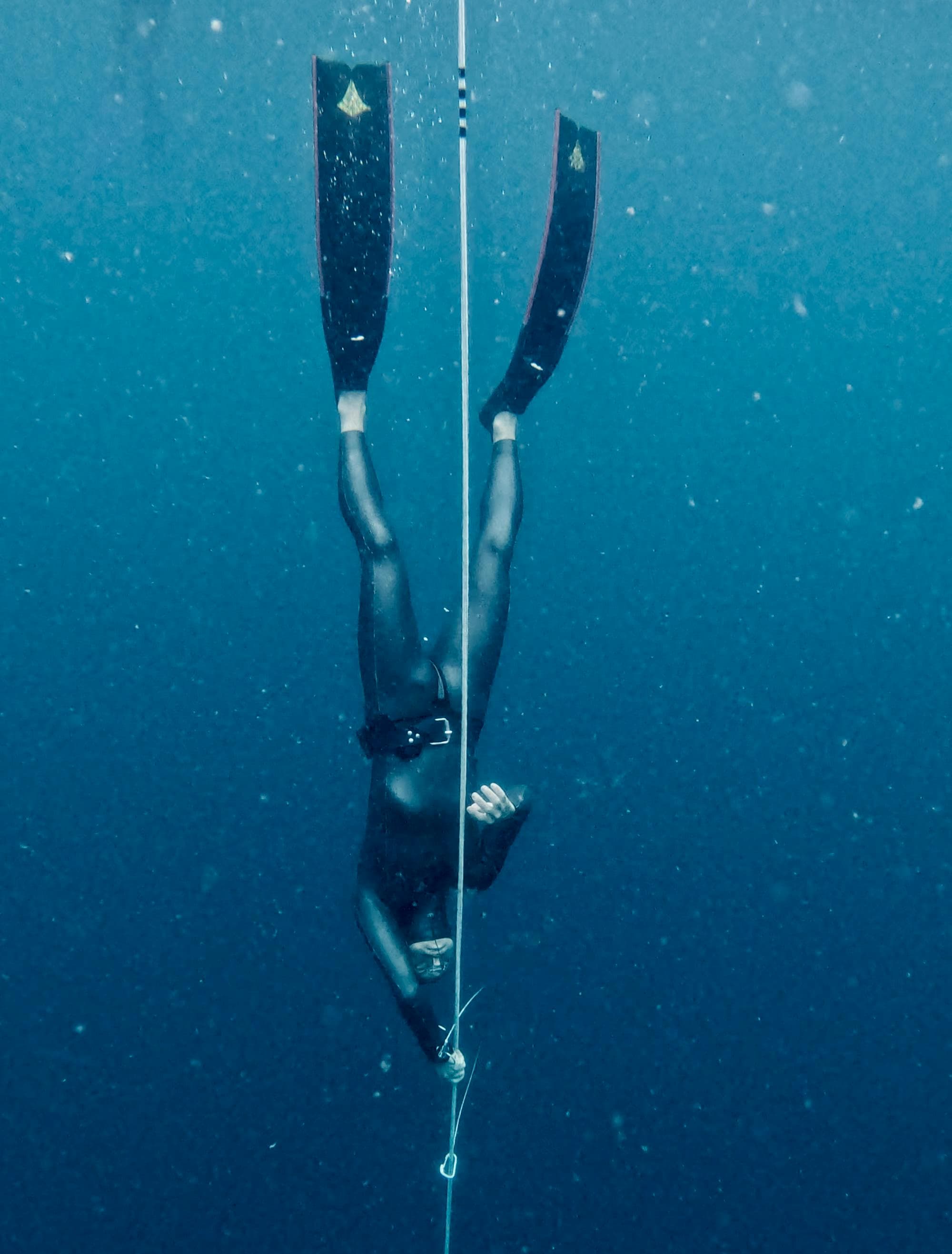
How Deep Can You Freedive? Depth Limits Explained
How deep can you freedive? It's the first question almost every new freediver asks — and the answer might surprise you. A complete beginner can typically reach 5–10 metres on their first attempts. After a beginner course, most divers comfortably reach 10–20 metres. With dedicated training over six to twelve months, 20–30 metres is achievable. Elite competitive freedivers push past 100 metres, and the deepest freedive ever recorded — Alexei Molchanov's constant weight monofin dive — reached an astonishing 136 metres.
Whether you're curious about what's physically possible or you want to understand what limits your depth, this guide covers the science, the records, realistic expectations, and how to safely progress deeper.
The Science of Depth
Several physiological mechanisms determine how deep a human can dive on a single breath. Rather than re-explain each one in full, here's a quick overview with links to our detailed articles.
Pressure and Boyle's Law
For every 10 metres of descent, water pressure increases by one atmosphere. That pressure compresses the air spaces in your body — lungs, sinuses, and middle ears — to half their surface volume at 10 m, a third at 20 m, and so on. Understanding this relationship is fundamental to equalization and depth progression. Read our full guide to Boyle's Law and equalization.
The Mammalian Dive Reflex
Humans share a powerful set of automatic responses with marine mammals. When your face contacts cold water, your heart rate drops, blood vessels in your extremities constrict, and your spleen releases extra oxygen-carrying red blood cells. This reflex is your body's built-in depth-protection system. Learn how the mammalian dive reflex works.
The Blood Shift
As you descend past roughly 30–40 metres, blood plasma moves from your extremities into the vessels of your chest cavity, effectively reducing the compressible volume of your lungs and protecting them from the crushing pressure. This remarkable adaptation is what allows elite divers to reach extreme depths without lung injury. Explore how the blood shift protects you at depth.
Oxygen and CO₂ Dynamics at Depth
At depth, the partial pressure of oxygen in your lungs is elevated — you feel fine. But as you ascend and pressure drops, that partial pressure can fall below the threshold for consciousness, creating a blackout risk in the final 10 metres of ascent. Understanding these gas dynamics is critical for safe deep diving. Understand oxygen and CO₂ dynamics during breath-holding.
World Records by Discipline
Competitive freediving is divided into several disciplines, each with different rules about propulsion and equipment. Here are the current records as of early 2025 (records change frequently — check AIDA International for the latest).
Constant Weight Monofin (CWT)
The diver descends and ascends under their own power using a monofin. This is widely considered the premier depth discipline.
Men: 136 m — Alexei Molchanov (2024)
Women: 123 m — Alenka Artnik (2021)
Constant Weight Bifins (CWTB)
Same rules as CWT, but using two separate fins rather than a monofin.
Men: 121 m — Arnaud Jerald (2023)
Women: 111 m — Marianna Gillespie (2024)
Free Immersion (FIM)
The diver pulls down and up a vertical rope — no fins allowed. Technique and relaxation dominate.
Men: 131 m — Alexei Molchanov (2023)
Women: 104 m — Alessia Zecchini (2023)
Constant Weight No Fins (CNF)
Considered the purest discipline — the diver swims down and back using only their body, typically with a modified breaststroke technique. No fins, no pulling the rope.
Men: 102 m — William Trubridge (2016)
Women: 78 m — Alessia Zecchini (2023)
No Limits (NLT) — Historical
In No Limits, the diver rides a weighted sled to depth and uses a lift bag to ascend. It's no longer an official competition discipline due to extreme risk, but it produced the deepest human freedive ever: Herbert Nitsch reached 214 metres in 2007, and attempted 253 metres in 2012 (suffering severe decompression sickness on the ascent).
Not sure what each discipline involves? Our guide to freediving disciplines explains the rules and differences.
How Deep Can a Beginner Go?
Let's set realistic expectations. Depth progression in freediving is non-linear — the first 20 metres are often the hardest because of equalization challenges, not breath-hold.
Untrained: 5–10 Metres
Most people who can swim and pinch their nose can reach 5–10 metres on a casual attempt. The primary limiter at this stage isn't breath-hold or fitness — it's equalization. The pressure change from the surface to 10 m is the greatest relative increase you'll experience at any depth (from 1 to 2 atmospheres, a 100% increase).
After a Level 1 Course: 10–20 Metres
A proper beginner course teaches you the Frenzel equalization technique, relaxation, efficient finning, and basic safety protocols. With these skills, most students reach 10–20 metres within the course. Some progress faster, but there's no rush.
Curious about what to expect? Read about your first freediving course.
6–12 Months of Training: 20–30 Metres
With regular pool and open water training, 20–30 metres is a realistic range after six months to a year. At this stage, the main breakthrough is usually mastering Frenzel equalization for consistent, comfortable descents.
The Equalization Gateway
Depth progression follows a staircase pattern, and equalization technique is the key that unlocks each new step:
Valsalva (pinching and blowing) works to about 10 m but becomes difficult and risky beyond that
Frenzel (tongue-piston technique) is reliable to about 30–40 m for most divers
Mouthfill (pre-loading air in the mouth before residual volume) unlocks depths beyond 40–50 m
Our equalization and Boyle's Law guide explains these techniques in detail. You can also explore how pressure changes at depth with our interactive depth and pressure calculator.
What Limits Your Depth?
Five main barriers determine how deep you can go. Understanding them helps you train smart and stay safe.
1. Equalization
The single most common depth limiter for beginners and intermediates. If you can't equalize, you can't descend — no matter how large your lung capacity or how calm your mind. Many divers plateau at a specific depth for weeks or months while they develop their equalization technique for the next range.
2. Breath-Hold Capacity
While equalization is usually the first barrier, breath-hold eventually becomes relevant — especially for deeper dives that require 2–3+ minutes of total dive time. The good news is that breath-hold is highly trainable, and much of the foundational work can be done on dry land. Learn how to increase your breath-hold time.
3. Anxiety and Mental Barriers
Depth triggers primal fear responses. The darkness, the pressure, the distance from the surface — it's psychologically demanding. Many experienced divers report that mental barriers are harder to overcome than physical ones. Visualization, gradual progression, and trust in your training are all part of the solution.
4. Nitrogen Narcosis
Beyond approximately 40–50 metres, the elevated partial pressure of nitrogen begins to produce narcotic effects — impaired judgment, euphoria, reduced coordination, and slowed thinking. It's often compared to being mildly intoxicated. Narcosis affects every diver differently and can vary from dive to dive. There is no way to develop "tolerance" to it. At extreme depths (70 m+), narcosis becomes a serious safety factor that can lead to disorientation and poor decision-making.
5. Lung Squeeze
At extreme depths, even with the blood shift, the lungs can experience barotrauma — small tears in the lung tissue or blood vessel walls. This is known as a lung squeeze or pulmonary barotrauma. It's most common in divers who push beyond their current blood shift development or descend too aggressively. It's a clear signal from your body that you've exceeded your current limit. Understand how the blood shift protects against lung squeeze.
Safety at Depth
Safety Warning: Deep freediving carries inherent risks that increase with depth. Loss of consciousness (blackout) can and does happen to experienced divers. Never freedive alone, never hyperventilate before a dive, and always have a trained buddy watching you.
Ascent Blackout Risk
The deeper you dive, the greater the blackout risk on ascent. As you return to the surface, the falling pressure reduces the partial pressure of oxygen in your blood. If it drops below the threshold for consciousness — typically in the final 10 metres — you black out. This is the leading cause of freediving fatalities. Read about shallow water blackout — the silent killer.
Never Dive Alone
A blackout underwater is survivable if a buddy is watching and responds within seconds. Without a buddy, it's almost always fatal. The buddy system isn't optional — it's the single most important safety practice in freediving. Learn about the freediving buddy system.
Gradual Progression
The body adapts to depth over time — blood shift development, equalization skill, CO₂ tolerance, and mental comfort all need gradual conditioning. Pushing too deep too fast is how injuries happen. Respect the process and celebrate small gains.
How to Safely Go Deeper
If deeper diving is your goal, here's a practical roadmap:
Master Equalization First
Before anything else, invest time in equalization. Practice Frenzel on dry land until it's effortless. If you're aiming beyond 40 metres, start learning mouthfill early. Equalization is the foundation — everything else follows from it.
Build Breath-Hold on Dry Land
CO₂ tolerance tables, O₂ tables, and relaxation breath-holds can all be trained safely on a couch. Building a solid breath-hold foundation on dry land means you can focus entirely on technique and relaxation when you're in the water.
Train With a Buddy or Club
Regular training with a buddy or local freediving club gives you safety coverage, feedback on your technique, and the motivation to keep improving. Many cities now have active freediving communities with weekly pool or ocean sessions.
Take Courses for Depth Milestones
Structured courses (Level 2 and Level 3) teach the specific skills needed for deeper ranges — advanced equalization, freefall technique, rescue protocols, and deeper safety knowledge. They're worth the investment. Explore our education resources to find the right path for your level.
Depth Is a Journey, Not a Destination
How deep can you freedive? The honest answer is: it depends on where you are in your journey. Five metres is an achievement for a first-timer. Twenty metres is transformative after a course. And for those who commit to years of patient, safe training, depths that once seemed impossible become routine.
But the most important number isn't how deep you go — it's how safely and consistently you get there and back. The ocean rewards patience. Train smart, never dive alone, and enjoy every metre of the journey.
Ready to start or continue your depth journey? Check out our safety resources and education guides for everything you need to progress safely.