How to Train for Freediving: A Complete Program for Beginners
Freediving performance comes from a combination of breath-hold capacity, equalization skill, physical fitness, mental calm, and water comfort. The good news: all of these are trainable, and much of the foundational work can be done on dry land. This guide provides a complete training framework for beginner and intermediate freedivers.
The Five Pillars of Freediving Training
Effective freediving training addresses five areas. Neglecting any one of them creates a bottleneck:
Breath-hold and CO₂ tolerance
Equalization
Physical fitness and flexibility
Mental training and relaxation
Water skills and technique
A well-rounded training week touches all five. Let's break each one down.
1. Breath-Hold and CO₂ Tolerance
Your ability to hold your breath comfortably directly affects how deep you can dive and how relaxed you are at depth. The primary limiter for most people isn't oxygen — it's CO₂ tolerance. Read our complete breath-hold training guide for detailed tables and progressions.
CO₂ Tables (2–3 sessions per week)
Repeated breath-holds with decreasing rest intervals and constant hold times. This trains your body to tolerate rising CO₂ levels — the primary driver of the urge to breathe. Start with 8 rounds at 50% of your max hold, with rest intervals decreasing from 2 minutes down to 30 seconds.
O₂ Tables (1–2 sessions per week)
Repeated breath-holds with increasing hold times and constant rest intervals. This trains your body's ability to function at lower oxygen levels. Start with 8 rounds, hold times increasing from 50% to 80% of your max, with 2-minute rests between each.
Static Apnea Practice
Once a week, do a relaxed maximum hold in a comfortable position. Don't push to the absolute limit — aim for about 80–90% of your max. Focus on relaxation techniques rather than willpower. Track your progress over weeks, not days.
Safety: Dry breath-hold training (on the couch or floor) is safe to do alone. Wet breath-hold training (face in water, pool, or ocean) must always be done with a buddy present. Read about shallow water blackout.
2. Equalization
Equalization is the most common depth limiter. If you can't equalise, you can't descend — regardless of how long you can hold your breath. Read our guide to equalization and Boyle's Law.
Daily Dry Practice (5–10 minutes)
Equalization is a motor skill that improves with repetition. Practise your Frenzel technique daily:
Pinch your nose and practise the tongue-piston movement
Use an Otovent balloon or similar device for resistance training
Practise with your head inverted (hanging off a bed) to simulate descent position
If working on mouthfill, practise the mouth-fill charge and release cycle
Consistent daily practice, even just 5 minutes, is far more effective than occasional long sessions. Troubleshoot your Frenzel technique.
3. Physical Fitness and Flexibility
Freediving doesn't require extreme fitness, but certain physical attributes directly improve performance:
Yoga and Stretching (2–3 sessions per week)
Flexibility — especially in the chest, intercostals, diaphragm, and shoulders — directly affects lung volume and ease of equalization. Yoga is the most popular cross-training activity among freedivers for good reason:
Chest-opening poses improve lung capacity and breathing comfort
Diaphragmatic stretching reduces residual volume and improves packing
Hip and shoulder flexibility improve streamlining in the water
The breathwork component of yoga translates directly to freediving relaxation
Cardiovascular Fitness (2–3 sessions per week)
A strong cardiovascular system means more efficient oxygen use and better recovery between dives. Low-intensity steady-state cardio is ideal:
Swimming (naturally builds water comfort and finning endurance)
Cycling (low impact, good for building aerobic base)
Running or jogging
You don't need to be an elite athlete. Moderate fitness with an emphasis on efficiency and relaxation matters more than raw power.
Core and Leg Strength
Strong legs improve finning efficiency — you want power with minimal energy expenditure. Core strength improves streamlining and body position in the water. Bodyweight exercises, swimming, and targeted leg work are all beneficial.
4. Mental Training and Relaxation
Ask any experienced freediver what limits their depth, and most will say their mind, not their body. Mental training is arguably the most underrated aspect of freediving performance.
Meditation (Daily, 10–20 minutes)
Regular meditation practice trains the skills you need during a dive: awareness without reaction, comfort with discomfort, and the ability to let go of intrusive thoughts. Even 10 minutes of daily breath-focused meditation makes a measurable difference.
Visualisation
Before training sessions, mentally rehearse your dives in detail. Visualise the breath-up, the duck dive, the descent, equalization at specific depths, the turn, and the ascent. Competitive freedivers use visualisation extensively — it reduces anxiety and improves execution.
Progressive Muscle Relaxation
Systematically tensing and releasing muscle groups trains body awareness and the ability to release tension on command. This directly translates to lower oxygen consumption during dives.
5. Water Skills and Technique
All the dry training in the world won't replace time in the water. Pool and open water sessions are where everything comes together.
Pool Training (1–2 sessions per week)
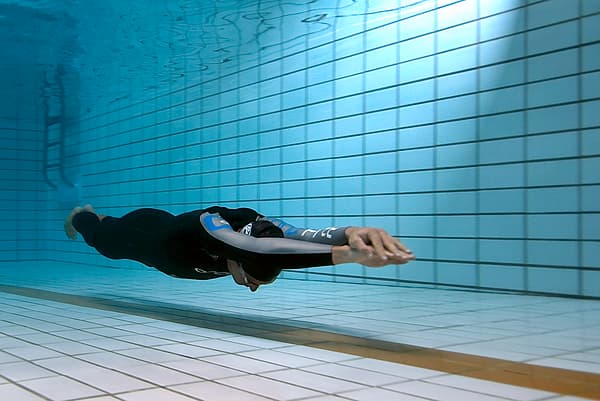
Dynamic apnea: Horizontal underwater swimming with fins — builds finning technique, streamlining, and CO₂ tolerance in the water
Static apnea: Breath-holds in the pool with a buddy — practise relaxation and the dive reflex
Technique drills: Duck dives, turns, finning efficiency, streamlining
Open Water Training (1–2 sessions per week or as available)
Depth dives with a buddy along a line
Free immersion (pulling on the line) to practise equalization without the distraction of finning
Warm-up dives, progressive depth, and always ending with a comfortable dive — not a maximal one
If you're new to open water depth training, a structured course is the safest way to begin.
Sample Weekly Schedule
Here's a balanced training week for an intermediate freediver:
Monday: CO₂ table (dry) + equalization practice + 10 min meditation
Tuesday: Yoga or stretching + light cardio (swim or cycle)
Wednesday: O₂ table (dry) + equalization practice + visualisation
Thursday: Pool session — dynamic apnea, technique drills
Friday: Rest or gentle yoga + equalization practice
Saturday: Open water session (depth training with buddy)
Sunday: Rest + static apnea (dry) + meditation
Adjust based on your schedule and access to water. Even 3–4 training sessions per week will produce significant progress. The key is consistency over intensity.
Common Mistakes
Training only breath-hold, ignoring equalization. Equalization is almost always the depth bottleneck — give it daily attention.
Pushing maximal efforts every session. Most training should be at 70–80% intensity. Max efforts once a week at most.
Neglecting rest and recovery. Your body adapts during rest, not during training. Overtraining leads to poor performance and increased risk.
Skipping mental training. Ten minutes of daily meditation will improve your diving more than an extra gym session.
Training breath-holds in water alone. Never. Blackout is always a possibility.
📚 Educational Content Only: This guide is for educational purposes and does not replace professional freediving instruction. Before attempting any breath-hold training, equalization techniques, or depth diving, you must complete a certified freediving course with a qualified instructor (AIDA, PADI, SSI, Molchanovs, or FII). Never practice breath-holding in water without a trained safety buddy present.
Getting Started
If you're just beginning, start with:
Take a course. A Level 1 freediving course gives you the foundation for everything above. Here's what to expect.
Establish a daily breathing and equalization practice. Even 10 minutes a day builds the foundation. Read our breathing techniques guide.
Find a buddy or club. Training partners provide safety, motivation, and feedback. Learn about the buddy system.
Be patient. Freediving rewards consistency. Progress is measured in months, not days.
Explore our education resources for course recommendations and structured learning paths, or visit our interactive tools for calculators and training aids.